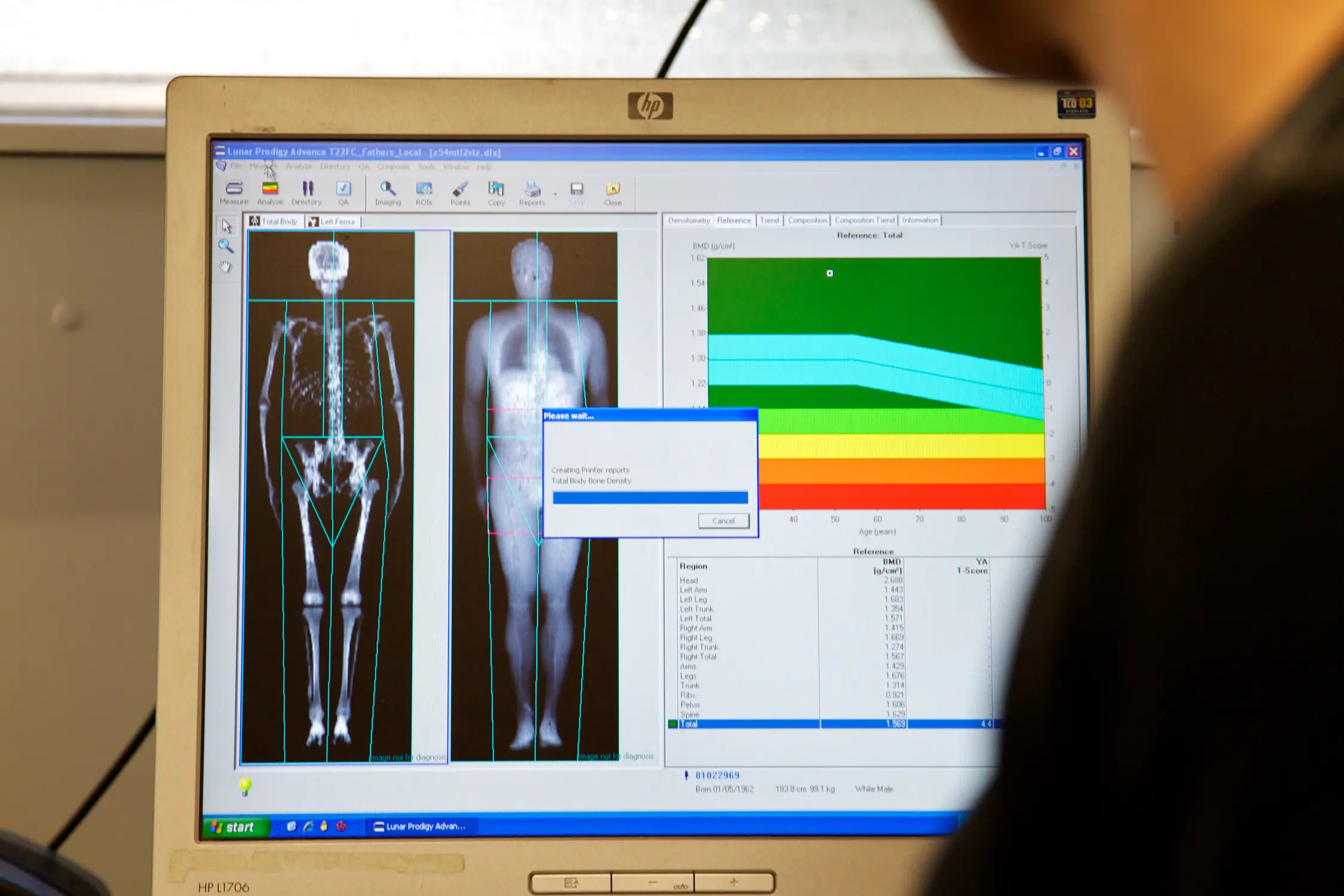
What is a DEXA scan?
The DEXA scan, short for dual-energy X-ray absorptiometry, is a low-dose X-ray test that provides a clear, clinically actionable picture of internal health. Long positioned as a diagnostic tool for older adults at risk of osteoporosis, forward-thinking clinicians now recognize its broader value as a DEXA body composition assessment for women across adulthood.
What a DEXA scan measures (beyond weight or BMI)
Unlike a scale or BMI, which only shows total weight, DEXA shows what that weight is made of and where it is distributed. A standard full-body DEXA scan for women measures:
- Bone mineral density, typically at the hips and spine, making it a highly sensitive bone density test for younger women to detect early bone loss
- Lean mass, which closely reflects muscle and is critical for strength, metabolism, and muscle mass longevity
- Total body fat and visceral fat, the deeper abdominal fat linked to insulin resistance, heart disease, and inflammation
What makes DEXA especially valuable in preventive and functional medicine is its ability to establish a baseline and track change over time, before symptoms or disease appear.
Small shifts in bone density, muscle mass, or visceral fat measured by DEXA often happen years before symptoms appear. Seeing those changes early allows you and your clinician to intervene with targeted nutrition, strength training, hormone optimization, and lifestyle support, long before disease develops.
When should you do a DEXA scan?
Conventional guidelines typically recommend DEXA scans for women over 65, or for younger women who have already experienced a fracture or have another major risk factor. The problem is that bone loss does not suddenly begin at 65. It starts much earlier and progresses quietly over time.
Women reach peak bone mass around age 30. After that, bone breakdown gradually exceeds bone building, with loss accelerating in the 40s and 50s. This is why DEXA scan age 30 is increasingly recognized as a clinically strategic moment for early screening.
At Parsley, we recommend at least one full-body DEXA after age 30—and ideally, a scan with full body composition every 1–2 years starting around 35. Early-stage osteopenia and osteoporosis can often be improved with timely intervention, and an early osteoporosis screening can detect subtle changes before these diagnoses arise.
Want clarity on your metabolic, hormonal, and bone health? Explore Parsley’s Longevity Labs.
Bone loss occurs much younger than we realize
Bone is a living tissue that is constantly being broken down and rebuilt. In childhood and early adulthood, bone building outpaces bone breakdown. That balance shifts earlier than most women realize.
- Around age 30, bone breakdown slowly begins to exceed bone formation
- Early 40s-50s: bone loss accelerates, particularly as estrogen levels fluctuate
- Menopause: 10 to 20 percent of bone mass is lost in just a few years
Despite this reality, routine screening does not typically begin until age 65. By then, the goal is no longer prevention, but damage control!
Most women do not feel bone loss as it is happening; their first sign is often a fracture of the hip, spine, or wrist. Nearly 50% of postmenopausal women will experience an osteoporosis-related fracture in their lifetime, and hip fractures alone are associated with a 20% increase in mortality within the first year.
These negative outcomes are preventable with early detection and intervention. From a functional medicine perspective, waiting decades to evaluate bone health does not make sense.
Why a DEXA scan after 30 is a clinically strategic move
Getting a DEXA in your 30s or 40s will tell you whether your current lifestyle supports bone health or undermines it. More importantly, it gives you time to course-correct.
“The DEXA is one of the few tests that can confirm whether your interventions are working. If you’re lifting, upping your protein, taking creatine, or using hormone therapy, a DEXA helps answer: ‘Is any of this actually moving the needle?’” says Dr. Robin Berzin, Founder & CEO of Parsley Health.
At Parsley, we recommend:
- One full-body DEXA scan after age 30 - this gives your clinician baseline data that can be tracked over time, reflecting our belief in treating root causes before symptoms escalate.
- Scans every one to two years starting at age 35 - A small annual decline in bone density or lean mass may not raise alarms, but a trend of small changes over a decade can be significant.
Muscle and bone are key drivers of how fast (or slow) you age. The more lean mass and bone strength you build—and the more visceral fat you keep in check—the better your odds of staying strong, mobile, and metabolically healthy over time.
DEXA is more than a bone test. It’s a longevity dashboard.
While bone mineral density gets most of the attention, a full-body DEXA scan captures metrics beyond fracture risk. It provides a comprehensive snapshot of DEXA body composition:
- Lean mass (muscle, organs, connective tissue)
- Fat mass (total and regional distribution)
- Visceral adipose tissue (the metabolically active fat around your organs)
- Bone mineral density (measured at high-risk sites like hips and spine)
Muscle mass, fat mass, and bone strength together predict healthspan and longevity far more accurately than weight or BMI. A woman might weigh the same at 40 as she did at 30, but her body composition could be dramatically different — less muscle, more fat, weaker bones. DEXA reveals these shifts so you can intervene and prevent metabolic dysfunction, sarcopenia (muscle loss), or bone fragility from taking hold.
Why longevity-minded women are using DEXA even without bone risk
Women who are motivated by performance, longevity, and metabolic health are increasingly seeking DEXA scans. Here's why:
Changes in muscle mass and bone strength indicate aging.
Low muscle mass (sarcopenia) is independently associated with increased mortality, functional decline, insulin resistance, and frailty. Bone strength is a marker of overall resilience and vitality.
Visceral fat measured by DEXA is a major predictor of metabolic disease.
Unlike subcutaneous fat (the layer under your skin), visceral fat is metabolically active and inflammatory. It's strongly linked to insulin resistance, cardiovascular disease, and hormonal imbalances. DEXA measures visceral adipose tissue with precision that waist circumference or weight can't provide.
DEXA objectively tracks the impact of interventions.
Are you lifting weights consistently? Eating enough protein? Taking creatine? Considering hormone replacement therapy? DEXA is one of the few tests that can objectively measure whether your efforts are working. It creates a feedback loop that helps you answer: "Is what I'm doing making a difference?"
For women focused on longevity, DEXA becomes a way to audit their biological aging trajectory with real data.
Target Ranges for bone density, lean mass, and body fat
DEXA results should always be interpreted with a clinician, but the following benchmarks can help provide context:
Bone Mineral Density (BMD)
T-scores compare your bone density to that of a healthy 30-year-old. So, for example, a T-score of -1.5 represents bone density 1.5 standard deviations below peak.
- T-score of +1.0 to -1.0: Normal bone density
- T-score of -1.0 to -2.5: osteopenia (low bone mass)
- T-score below -2.4: osteoporosis
Lean Mass
This should ideally comprise at least 70 percent of total body weight. If lean mass drops significantly below 70 percent, especially alongside low bone density, that’s a red flag. You should intervene with increased resistance training, protein, and possibly creatine or hormone support.
Body Fat Percentage
Targets vary, but 18-24 percent is a solid range for most longevity-minded women. Extremes in either direction (very low or very high body fat) can disrupt hormone balance, menstrual cycles, and metabolic function.
Fat distribution matters too: visceral fat is more concerning than subcutaneous fat on the hips and thighs. Even women who appear lean can carry excess visceral fat, which BMI does not detect. Elevated visceral fat can increase the risk of insulin resistance, fatty liver, and cardiovascular disease.
What women should know before getting their first DEXA scan
The scan is quick, painless, and non-invasive. It typically takes 10 to 20 minutes and involves no needles, no contrast dye, and minimal radiation exposure. You simply lie still on a padded table while a scanner arm passes over your body.
How often to repeat it: for prevention and longevity, repeat the scan every one to two years. If you're implementing specific interventions (e.g., starting HRT, changing your training protocol), you might scan more frequently to track progress. A DEXA scan delivers approximately 1/10th to 1/100th the radiation dose of a standard chest X-ray, as low as background radiation.
The value of getting one early, even if results are strong: A baseline DEXA when you're healthy gives you a reference point for comparison. It tells you where you started so you can track subtle changes over time.
Insurance coverage: Insurance coverage varies and is often limited to under age 65. If your insurance plan does cover a scan, it might only pay for the bone density portion. We recommend investing in a full DEXA body composition scan out of pocket. It’s one of the highest-value tests you can do.
At Parsley Health, we believe it’s better to know now so that you can act sooner. Why wait for symptoms to escalate or for guideline-recommended ages that ignore biological reality, when these issues are reversible? Your healthspan is too important to leave to chance.
How Parsley helps you interpret and act on DEXA results
Getting a DEXA scan is valuable. Understanding what it means for your body and your goals? That's where we come in.
The board-certified clinicians at Parsley Health interpret DEXA results through a whole-body, root-cause approach. Your personalized plan might include:
- Strength training protocols tailored to your lean mass and bone density
- Nutrition optimization (protein targets, micronutrients for bone health, anti-inflammatory eating patterns)
- Hormone assessment and optimization (especially for women in perimenopause or menopause)
- Targeted supplementation (vitamin D, calcium, magnesium, creatine)
- Metabolic interventions to reduce visceral fat and improve insulin sensitivity
We treat DEXA results as a starting point for building lifelong strength, resilience, and vitality.
Start understanding your body and building lifelong strength. Explore Parsley's Longevity Labs and longevity care options.